AI model cost management | Visibility and governance guide
Engineering and platform teams are losing visibility over AI model costs and management. Cloud Ctrl on how to attribute, govern, and control it in your toolchain.
Visibility, attribution, and governance for the tools your team is already running
Why AI model cost visibility is now an engineering team responsibility
A conversation is happening across engineering teams right now that isn't getting enough airtime.
Developers are more productive than ever. AI tooling has genuinely changed what a skilled engineer can deliver in a day, and most platform and engineering leads are glad for it.
But those same leads are watching AI model cost management become one of the most difficult problems on their plate: costs that are hard to predict, harder to govern, and nearly impossible to attribute to specific outcomes. The newest models are more capable, but they're also more expensive. And developers, incentivised to move fast and produce more, will naturally reach for the most powerful tool available, whether or not the task requires it.
Which brings us to the pattern we're hearing from engineering managers and platform leads across our customer base: developers are choosing models based on capability, not cost and task appropriateness, and unless someone is actively governing it, the spend compounds quickly.
Microsoft's 2026 Work Trend Index found that the number of active agents in the Microsoft 365 ecosystem has grown 15x year over year, rising to 18x in large enterprises. As agentic AI use scales, so does the cost of every token those agents consume. For the people responsible for managing that spend, the governance question is no longer theoretical.
Why doesn't traditional FinOps solve this?
Cloud cost management has matured significantly over the past decade. Most enterprise development teams have some version of a FinOps practice: tagging resources, monitoring spend, setting budgets, reviewing waste. Cloud Ctrl was built to bring this discipline to Azure and AWS environments in a way that's actually usable for the teams doing the work.
But AI model costs don't behave like cloud infrastructure costs. They're not attached to resources sitting idle. They're attached to decisions: which model a developer chose for a given task, how many tokens a prompt consumed, whether an agent ran a simple query or a complex reasoning chain.
The FinOps Association has recently introduced what it's calling Token Economics — an attempt to bring the same discipline to AI model spend that FinOps brought to cloud. The intent is right. But the challenge isn't just measurement; it's that the thing being measured keeps evolving. Model pricing shifts. New models arrive. What cost $X last month may cost very differently next month, and engineering teams need visibility that keeps pace with that change.
What does ungoverned AI model spend look like in practice?
Without governance, the pattern is consistent. When a developer discovers a newer, more capable model, they'll switch to it. Often for good reasons; the output is genuinely better, and then others follow. Within weeks, a team running a cost-efficient model stack has migrated to something significantly more expensive, with no formal decision made and no visibility at the platform or management level until the bill arrives.
The frustration we hear from engineering managers is consistent: developers don't prioritise model costs; they prioritise productivity and the best tool. From their perspective, that's exactly what they're being asked to deliver. Accountability for what the tools cost sits with the platform lead or engineering manager who doesn't have the visibility to make good decisions in real time.
Blaming developers for chasing capable models is like blaming engineers for spinning up cloud resources a decade ago. The behaviour is rational. The missing piece is governance that keeps pace, and that's a tooling problem, not a people problem.
How Cloud Ctrl has evolved to address AI model cost management
The AI cost layer does for model spend what Cloud Ctrl has always done for cloud workloads: it pulls raw usage directly from each provider; tokens in, tokens out, cached and reasoning tokens, requests and model mix, and turns it into a single, normalised view of what AI is actually costing your team.
Connectors span the tools development teams actually run: OpenAI and Anthropic, GitHub Copilot, OpenRouter, Cursor, and xAI, so you're not limited to a single vendor's reporting. Because usage is ingested at the request and model level rather than as a monthly invoice total, spend can be attributed back to the model, the user, and the API key. That makes it possible to compare cost per project across providers, identify the model quietly burning the budget, and assess whether switching to a cheaper or faster model would move the needle.
Cloud Ctrl surfaces this information where your team already reviews cloud spend, not in a separate AI dashboard that requires a second login and a context switch. The AI view breaks spend down by provider and model, with a leaderboard of the most expensive models, most active users, a charge-mix breakdown, and stacked and pie views that show where the money is going at a glance. A drill-down dialogue lets you move from a headline figure to the individual model and request pattern behind it without leaving the screen.
Because it's part of Cloud Ctrl's existing reporting and alerting cadence, your team gets the same treatment you already rely on for Azure and AWS: scheduled reports, threshold alerts, and tenant-scoped visibility that lets each team see only its own AI spend. The practical effect: you can ask "what did our AI cost last month, and which model drove it?" and get an answer in the same tool you use to track cloud infrastructure.
The underlying principle hasn't changed. The best cost management is the kind people use. Visibility that requires a separate workflow, a separate login, or a separate conversation doesn't change how developers make day-to-day decisions. Cloud Ctrl was designed to sit where the work happens, and the AI cost layer extends that same philosophy.
What should engineering and platform teams be doing now?
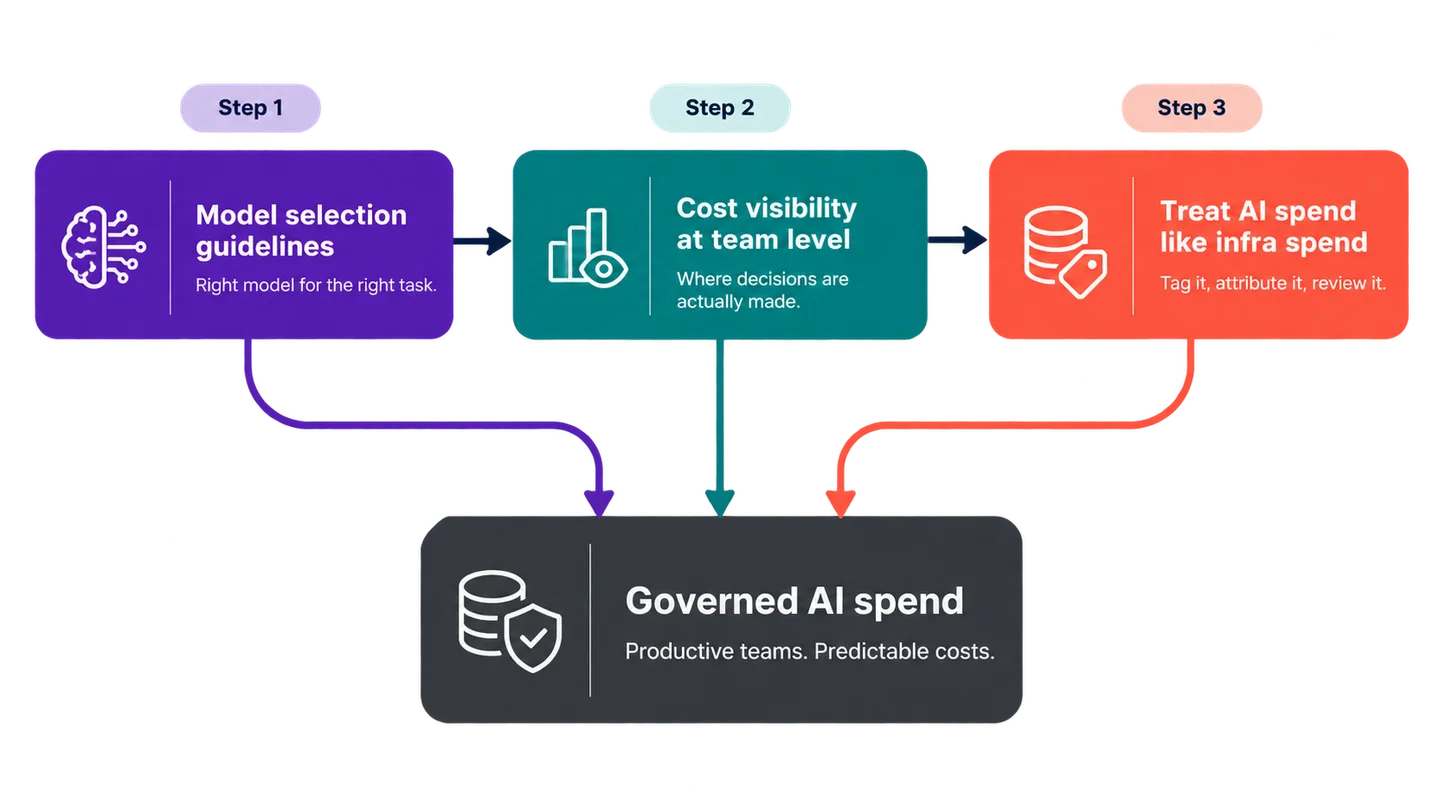
Whether or not you're using Cloud Ctrl, there are three things worth putting in place now.
-
Establish model selection guidelines. Not every task requires the most capable model available. A clear internal framework for which models are appropriate for which task types, with cost as an explicit consideration, reduces unconscious spend without restricting productivity.
-
Make AI costs visible at the team level. Spend that's only visible to finance or senior leadership doesn't change developer behaviour. Bringing cost visibility into the same environment where development decisions are made is where governance takes effect.
-
Treat AI model spend like infrastructure spend. Tag it, attribute it, review it. The discipline that brought cloud costs under control is directly applicable — the tooling just needs to catch up to the new environment.
If you want to understand how Cloud Ctrl can help your team get ahead of escalating AI costs, get in touch.
Cloud Ctrl is a cloud and AI cost management platform for development teams, software distributors, and MSPs.